
The Federal Retirement Thrift Investment Board's (FRTIB), one of the US government's main retirement funds, decision to change the benchmark index for gaining international exposure will channel $3.6 billion (Rs 30,000 crore) inflows into domestic equities. India has a weightage of 5.3 per cent, seventh-most in the new MSCI ACWI IMI ex USA ex China ex Hong Index, which FRTIB now plans to use. India isn't part of the current developed markets-dominated MSCI EAFE index that the pension fund uses.

Increasing awareness about mutual funds, ease of transactions through digitisation and sharp surge in equity markets have aided asset management companies to add a staggering 3.17 crore investor accounts in 2021-22, with experts saying the trend is likely to continue this fiscal as well. This was a significant rise from 2020-21 when 81 lakh accounts (or folios in mutual fund parlance) were opened, data with the Association of Mutual Funds in India (Amfi) showed. The ongoing financial year too appears to be promising in terms of folios as increase in investor accounts will enable people to move beyond fixed deposits and savings accounts, said Priti Rathi Gupta, founder of LXME, a financial platform for women.

Announcement of macroeconmic data such as industrial production and inflation, the US Federal Reserve's interest rate decision along with trends in global equities would dictate movement in the stock market this week, analysts said. Besides, foreign fund trading activity would also guide the trends in equities. "All eyes are now on the US Fed policy outcome for cues, which is scheduled on June 14. In the following sessions, the European Central Bank (ECB) and Bank of Japan (BoJ) will also announce their policy decisions.

The index is currently trading at 149 per cent of its historical P/B valuation, surpassing its previous peak of 125 per cent made in 2020-21.

Tata Steel fell the most by 4.21 per cent. NTPC, Tata Motors, HCL Technologies, Mahindra & Mahindra, State Bank of India, Power Grid, Tech Mahindra, Larsen & Toubro and JSW Steel also declined. HDFC Bank was the only gainer from the pack. In Asian markets, Seoul, Tokyo and Hong Kong settled in the positive territory while Shanghai ended lower.
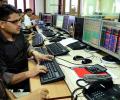
From the Sensex pack, HCL Technologies, Infosys, Wipro, Bharti Airtel, Larsen & Toubro, Mahindra & Mahindra, Tata Consultancy Services and Asian Paints were the major gainers. Axis Bank, IndusInd Bank, Bajaj Finance, JSW Steel, State Bank of India and Tata Steel were among the major laggards.

Equity benchmark Sensex rallied 478 points on Monday after gains in index majors HDFC, Infosys and Kotak Bank despite a negative trend in the global markets.

The market capitalisation of BSE-listed firms jumped to an all-time high of Rs 304.53 lakh crore on Wednesday, buoyed by an unprecedented rally in equities where the BSE benchmark Sensex ended over the 67,000-mark for the first time ever. Rallying for the fifth day running, the 30-share BSE Sensex climbed 302.30 points, or 0.45 per cent, to end at its lifetime closing high of 67,097.44 points. During the day, it jumped 376.24 points, or 0.56 per cent, to reach its all-time intra-day peak of 67,171.38 points.

In the Sensex pack, HCLTech rose the maximum by 3.12 per cent, followed by ITC which gained 2.73 per cent and M&M went up 2.61 per cent. TCS climbed 2.44 per cent. Tech Mahindra, Wipro, L&T and Maruti were among the other major gainers.

ICICI Bank was the biggest loser in the Sensex pack, slipping 2.81 per cent, followed by Mahindra & Mahindra, State Bank of India, UltraTech Cement, IndusInd Bank, Kotak Mahindra Bank, Tata Motors, Bajaj Finserv, Axis Bank and Power Grid. Tech Mahindra, Bharti Airtel, Infosys, Asian Paints, Hindustan Unilever, Larsen & Toubro and Titan were the gainers.

Global trends, macroeconomic data, and the outcome of the US Fed policy meeting are the major factors that will drive the movement in the domestic equity markets this week, analysts said. "In the upcoming data-centric week, the focus will be on crucial releases, including inflation data from India and the US. "Indian inflation is expected to rise, while US inflation will remain steady.

Investors' wealth eroded by Rs 3.46 lakh crore on Wednesday as equity markets took a sharp tumble amid weak global trends and foreign fund outflows. The 30-share BSE Sensex fell by 676.53 points or 1.02 per cent to settle at 65,782.78. During the day, it plunged 1,027.63 points or 1.54 per cent to 65,431.68. In line with the weak trend in equities, the market capitalisation of BSE-listed firms eroded by Rs 3,46,947.54 crore to Rs 3,03,33,258.69 crore.

Bajaj Finance was the top gainer in the Sensex pack, rising around 11 per cent, followed by Titan, Tata Steel, SBI, M&M, HDFC, IndusInd Bank and Reliance Industries. On the other hand, Sun Pharma, Nestle India and UltraTech Cement were among the laggards.

Higher valuation creation in companies beyond the top 100 has given the domestic markets a shot at a $4 trillion market capitalisation (mcap) - a club exclusive to three countries currently. On November 23, the mcap of all BSE-listed stocks finished at a new record of Rs 328.33 trillion ($3.94 trillion), despite the benchmark indices ending with losses. The mcap was propelled by gains in the broader market, including small and midcap stocks - a trend dominant this year.
The government on Tuesday proposed reducing the long-term capital gains tax on immovable properties to 12.5 per cent from 20 per cent, but removed the indexation benefits to adjust for inflation, a move experts termed as "negative" for sellers.

The joint venture of Jio Financial Services and BlackRock to foray into India's asset management space could be disruptive but not disastrous for incumbent industry players, analysts said on Thursday. As an investment strategy, analysts suggest investors stay put in shares of those AMCs that consistently improve business metrics, and where market capitalisation-to-asset under management (AUM) valuation is not stretched. However, growth expectations of incumbent players may get trimmed in the medium-to-long term, analysts said, once the Jio-BlackRock JV unveils its plans, discounting the looming challenge as significant enough to dent their profitability.
Benchmark equity indices Sensex and Nifty closed higher on Friday after two days of fall, helped by buying in metal, telecom and auto stocks amid a firm trend in global markets. Automakers led by Maruti Suzuki India, Hyundai, Mahindra & Mahindra reporting robust wholesales of passenger vehicles and GST collections crossing Rs 1.50 lakh crore for the third straight month in May also added to the optimism. The 30-share BSE Sensex climbed 118.57 points or 0.19 per cent to settle at 62,547.11.

Market participants attribute the stability to the Reserve Bank of India's timely intervention in the foreign exchange market, both in terms of selling and buying dollars.

HUL was the top gainer in the Sensex pack, rising around 2 per cent, followed by TCS, ITC, Asian Paints, HDFC, HCL Tech and Nestle India.

Equity markets began the new financial year with smart gains on Friday, with the Sensex rallying over 708 points to recapture the crucial 59,000-mark following gains in index majors HDFC twins and Reliance Industries, along with foreign fund inflows. On the first day of trading in the new financial year, the BSE barometer rallied 708.18 points or 1.21 per cent to settle at 59,276.69. During the day, it jumped 828.11 points or 1.41 per cent to 59,396.62. The broader NSE Nifty advanced 205.70 points or 1.18 per cent to settle at 17,670.45.

There is polarisation among sectors with IT and healthcare receiving the lion's share of FPI money in the past two quarters.

Equity benchmark Sensex rebounded 454 points on Thursday, boosted by gains in index heavyweight Reliance Industries amid a positive trend in global markets.

Around 75 per cent, or 372 stocks, that are part of the BSE500 are trading at least 10 per cent below their all-time high levels, despite the index hitting a record high 20,515 points on the BSE in intra-day trade on Wednesday, surpassing its previous high of 20,390 touched in March 12. The index, which accounts for 93 per cent of BSE listed companies' market capitalisation, has gained 8 per cent from its recent low of 18,983, touched on April 19. In comparison, the benchmark S&P BSE Sensex gained 6 per cent over the same period, but is still nearly 4.5 per cent away from its all-time high of 52,517 that it hit on February 16.

Overseas investors have pulled out a net Rs 1,14,855.97 crore from the Indian markets in the current year so far, amid heightened geopolitical tensions and inflation concerns. Foreign portfolio investors have sold domestic equities worth Rs 48,261.65 crore so far this month, taking the year-to-date tally this year to a massive Rs 114,855.97 crore, according to depositories data. The exodus of foreign investors was largely owing to inflationary pressures and deepening global macroeconomic conditions following the Russia-Ukraine war, experts said.

Domestic macroeconomic data announcements, global trends, quarterly earnings and foreign fund trading activity would dictate terms in the equity markets this week, analysts said. Besides, movement of rupee against the US dollar and global oil benchmark Brent crude price would also guide the trading pattern in the equity markets. "From a macroeconomic perspective, market participants will be closely observing key events like the upcoming release of the US manufacturing PMI data, US services PMI data and US non-farm payrolls scheduled between August 1 and August 4.

In terms of stock selection, India continues to benefit from two phenomena - the big getting bigger and availability of quality stocks in relative abundance compared with its Asian peers.

Among the Sensex firms, Wipro jumped over 6 per cent, the most among the frontline companies. HCL Technologies, Tata Motors, Maruti, Tata Steel, Infosys, Tech Mahindra, Larsen & Toubro and JSW Steel were the other major winners. State Bank of India, Bajaj Finance, ICICI Bank, HDFC Bank, Axis Bank and IndusInd Bank were among the laggards.

Among the Sensex firms, JSW Steel, Tata Motors, Tata Steel, Tata Consultancy Services, NTPC, Wipro, HCL Technologies, State Bank of India, Larsen & Toubro, UltraTech Cement, IndusInd Bank, Kotak Mahindra Bank, Power Grid and Reliance Industries Limited were the major laggards. Mahindra & Mahindra and Bajaj Finance were the gainers.

The Reserve Bank of India's (RBI's) record surplus transfer to the government has raised hopes among bond traders that the government might reduce its gross borrowing for the current financial year (2024-25/FY25) by up to Rs 1 trillion. The RBI approved a dividend of Rs 2.11 trillion for the central government for 2023-24, marking an increase of roughly 141 per cent from 2022-23 (FY23). In addition, the contingency risk buffer has been raised to 6.5 per cent from the previous 6 per cent.

After two months of buying, foreign portfolio investors (FPIs) have turned net sellers in October by pulling out Rs 12,278 crore from Indian markets. As per depositories data, FPIs took out Rs 13,550 crore from equities but invested Rs 1,272 crore in the debt segment during October 1-29. The total net outflow stood at Rs 12,278 crore during the period under review.

Among the Sensex firms, JSW Steel, Tata Steel, Tech Mahindra, Infosys, Wipro, Tata Consultancy Services, Nestle, HCL Technologies, HDFC Bank and Maruti were the major laggards. IndusInd Bank, ITC, Bharti Airtel and State Bank of India were among the winners.

Build a portfolio diversified across market caps, investment styles, and geographies.

Even as the slowdown in the information technology (IT) services sector deepens, banking, financial services and insurance (BFSI), as well as oil and gas companies, emerge as the primary drivers of corporate earnings in the country. The IT services sector's share in corporate earnings declined to a five-year low of 17.4 per cent in the second quarter (Q2) of 2023-24 (FY24), whereas banks and finance companies accounted for 46.5 per cent, and oil and gas firms contributed 16.8 per cent. At their peak, IT services firms like Tata Consultancy Services (TCS), Infosys, HCLTech, and Wipro represented just over a third of the combined net profit of all listed companies in the Business Standard sample.

'It is advisable to stay away from the markets for now and buy only on a dip.'
Among the Sensex firms, Infosys, Bharti Airtel, NTPC, Tata Motors, IndusInd Bank, Bajaj Finance, ICICI Bank, Tech Mahindra, Titan and Axis Bank were among the major laggards. Tata Steel, State Bank of India, Mahindra & Mahindra, Maruti and Nestle were the gainers.

Bajaj Finance, ICICI Bank, Bajaj Finserv, IndusInd Bank, Infosys, Kotak Mahindra Bank, Wipro, and Reliance Industries were among the other laggards. On the other hand, Larsen & Toubro, Hindustan Unilever, Power Grid, Asian Paints, Nestle and Mahindra & Mahindra were the major gainers.
Benchmark stock indices Sensex and Nifty cut short their four-day gaining streak to close lower by half a per cent on Wednesday due to profit-taking in banking oil and metal stocks amid weak trends in global markets.

The mutual fund (MF) industry added a record Rs 10 trillion to its total assets under management (AUM) in 2023, taking the cumulative tally past the Rs 50 trillion mark for the first time, in December. This 20 per cent growth in AUM last year was fuelled by a robust rally in the equity markets and a record Rs 1.62 trillion net inflows into active equity schemes. In another first, the AUM linked to systematic investment plans, too, hit Rs 10 trillion by the end of 2023.
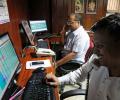
Bajaj Finance was the biggest gainer in the Sensex pack, rising 2.70 per cent, followed by Power Grid, IndusInd Bank, NTPC, Bharti Airtel, ITC, Bajaj Finserv, Infosys, Nestle, Tata Steel, Tata Consultancy Services, Titan and Axis Bank. Reliance Industries, Mahindra & Mahindra, Maruti and State Bank of India were among the laggards.

Among the Sensex firms, Larsen & Toubro, UltraTech Cement, JSW Steel, Titan, Bajaj Finance, Wipro, Tech Mahindra and Nestle were the major laggards. Maruti, Power Grid, Axis Bank, State Bank of India, NTPC, HDFC Bank, ITC and IndusInd Bank were the gainers.
